How to learn Japanese
I have been studying Japanese on and off for more than 10 years.
During that time I have tried a lot of tools and resources.
Some of these were very helpful, some not so much.
Thinking back, I wasted a lot of time studying using methods that didn't really provide results.
In this post, I want to give my two cents as to what works, and what doesn't, when it comes to learning Japanese.
Mindset
Japanese is different.
Tools that work for learning other languages, especially those that are similar to English, don't work for Japanese.
Japanese is fundamentally different from European languages. You need to completly relearn how to speak, read and write.
You need an approach that is specifically tailored for Japanese, becuase Japanese has a lot of concepts and challenges that are unique to Japanese.
Japanese is difficult.
If you are reading this, I might not need to tell you, but Japanese is one of the most difficult languages to learn.
If your mindset is that you are "going to spend the next X years learning Japanese", you are thinking about it wrong.
Japanese will take a lot of time to master, and anyway "mastery" can't really be defined when it comes to languages. So you should think about learning Japanese as more of a hobby, rather than a goal.
Something that you can continue to work on whenever you have time.
And if you don't enjoy studying itself, you will probably get frustrated and give up sooner or later.
Learning Japanese is not hard in the way that Math or programming is hard, where understanding a single concept can be difficult.
The difficult part of learning Japanese is the tenacity needed to keep studying day after day.
Anyone can learn Japanese, granted that they put in the time needed.
Time spent is king
This blog post is about different methods for learning.
But, as hinted above, what is more important than what tool you use, is how much time you spend using it.
Languages, and especially Japanese, demand an enormous time investment.
No clever method will change this fact.
If you are serious about learning Japanese, you should think about studying, not as how many minutes a day, but as how many hours.
Have a goal
What do you want to do with Japanese?
If the answer is that you just think it would be cool to know how to speak Japanese, you will burn out quickly.
You should have some concrete goal in mind, like a book you want to read or person you want to be able to talk with. This will make the time you spend studying feel worthwhile.
Preferably, it should be something that is not possible without knowing Japanese. Something untranslated or untranslatable.
What does not work
Apps
Well, not all apps, as we will see in the other sections.
But apps like Duolingo, Memrise, Mondly etc.
For the sake of brevity, let me just list the problems with these apps.
Notice how many of these are directly related to the mindset section above.
- They instil the wrong mindset. They make it seem like you can learn a language "in 15 minutes a day".
- They teach many languages, that is, they are not tailored to Japanese.
- There is no journey or discovery, just memorization of a curriculum someone decided for you.
- They are boring. And motivation is everything.
Low-effort studying
There is a trend of people claiming that learning a language is all about input.
That if you're simply exposed enough to it, you will learn it eventually.
"Like how a baby learns."
I'm sorry to tell you, but you are not a baby, and this approach will not work.
In my experience, learning requires you to actively participate in and engage with the material.
While studying you need to stop, research, think, write and mentally process what you are learning using your own mind.
Some examples of low-effort studying would be, listening to a podcast while doing something else, reading and just translating every word you don't know without taking any notes, watching a TV show and not rewinding when you don't understand what is said.
I'm not saying that doing this kind of passive input is completely useless, but it has to be combined with active learning.
Romaji
Romaji is the representation of Japanese using the English alphabet.
It is a complete waste of time.
There is no advanced material, and no native content that uses romaji.
You will reach a wall before learning the language to any useful degree.
What works
Getting started
The ultimate goal in the beginner/intermediate phase of your learning journey should be to reach a level where you can learn from native material.
That is, movies, books, comics etc. in Japanese.
But of course, these kinds of things are simply too difficult for a beginner.
My recommendation is that you start with Human Japanese. It is a textbook in app form. In my opinion it has the best explanations of the central concepts of Japanese.
Next, you need some easy reading. Here are a few suggestions.
Textbooks
Any textbook on Japanese will do. They usually have some easy texts that you can use as reading material.
Satori Reader
Can be found here.
It is a website that is made by the team behind Human Japanese.
It has easy stories and articles with explanations of words and grammar embedded in the text.
japanesetest4you.com
Can be found here.
This is a site that was made for studying for the JLPT exam. Even if you don't intend to take the exam, the material categorized by difficulty is very useful.
JapanesePod101
Can be found here.
A podcast-based learning site. If you pay for it you will have access to the script for each episode.
NHK easy news
Can be found here.
News articles in simply Japanese.
In the following sections I will explain more about how to engage with these resources and go more into detail about how to learn specific concepts.
Vocabulary
This is an important thing to work on in all stages of learning. And at an advanced level, it is pretty much going to be the only thing that is left; there are always more words to learn.
For practicing vocabulary, you should use flashcards. The most popular app for this is Anki.
I recommend making two decks: reading and speaking.
The reading deck should show a sentence in Japanese, and you should try to remember what it means in English (or your native language).
The cards should contain the original Japanese sentence, the Japanese sentence written only using Hiragana and lastly the English translation.
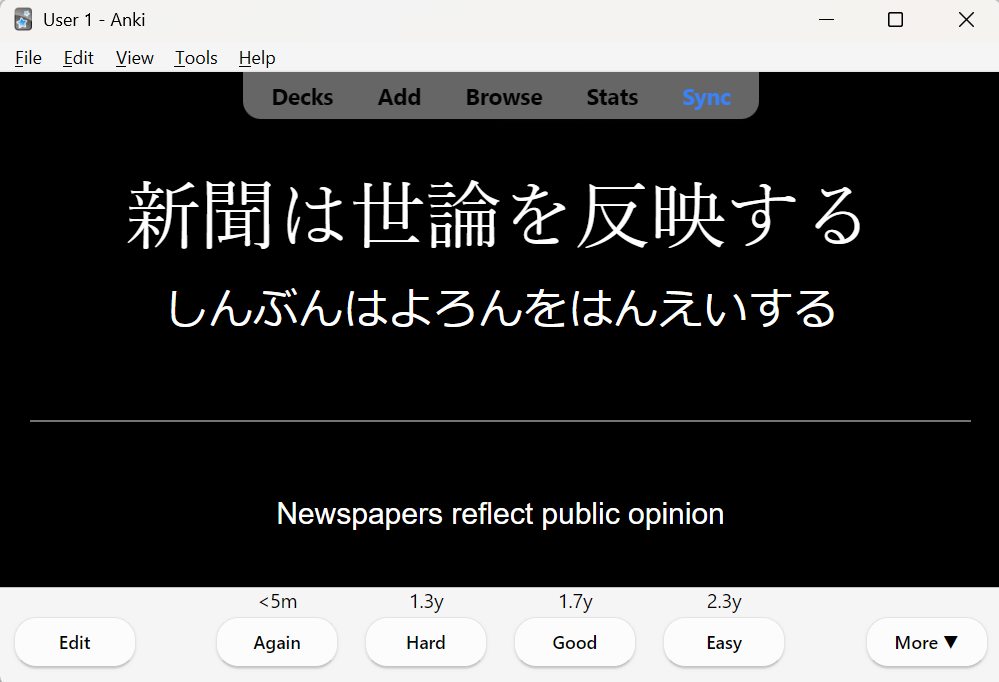
As a beginner, you can show the Hiragana on the front of the card. But as you get more experienced, you should move it to the back and recall the reading of the Kanji as part of the exercise.
The speaking deck should show a sentence in English on the front and Japanese on the back.
You should have one focus point for each speaking card, that is, a word or a grammar point. You should not worry about remembering the translation word for word, but simply mark your review as good if you remember the focus point.
You should only add words to the speaking deck that you imagine that you would actually use in a conversation. Be careful not to add words that are only used in literature.
You should NOT
- Add single words.
- The retention is terrible when doing this.
- Add a sentence to both decks.
- It's not worth doubling your time spent reviewing a sentence just to learn it "both ways".
- Use other peoples decks.
- You have no connection with the cards, no memory to recall when seeing them.
- Mass-create cards with sentences that you have not encounted "in the wild".
- Same issue as the point above.
Finding your sentences
So how should you find the sentences to add?
You can add sentences any time that you interact with Japanese.
That might be a textbook, a manga, a TV show, a conversation, a news article.
This is what some people refer to as "sentence mining"
I don't really like this expression since it implies that the goal is to just go out and find as many sentences as possible. The sentences should be things that you naturally encounter during your studies.
My personal favorite ways of boosting vocabulary are
Netflix. Or any steaming service that has Japanese subtitles. You hear the words, see the visuals to go with them, and read the subtitles. I love this for vocab because you get the whole package, and lot's of context for your brain to hang on to. You can check out Language reactor, a browser add-on that makes it easier to study using Netflix.
Visual novels. Visual novels are books packaged as games, with visuals and voice acting. They have many of the strengths of Netflix, and stopping after each sentence is a built-in feature.
Don't add everything
A pitfall to avoid when adding sentences to your deck is to just add a sentence every time there is a word that you don't know.
Doing this you might spend a lot of time learning some very obscure words early on.
Learning common words has a lot more "bang-for-your-buck" when it comes to overall comprehension.
What I found worked very well was to check the words on Jisho. This online dictionary has words marked by their JLPT level.
Using this information, you start by adding a sentence if it contains only N5 words. Then, once you feel that you are not adding enough sentences during your study sessions, you start adding N4 words and so on.
This is an easy way to learn words in the "correct" order.
If there are days where you don't feel like addings cards, or you have too many reviews, you can write notes instead. I note down a word on a piece of paper with the Kanji, the pronunciation, and the translation.
Then, I try to skim over the list throughout the day.
Doing this, a few of the words stick without having to create and review cards.
Sometimes combine the two, adding a note instead whenever I decide not to add the sentence to my flashcards for whatever reason. But be careful that you don't spend too much time on words that are beyond your level.
Hiragana / Katakana
Japanese has three scripts. Hiragana, Katakana and Kanji.
Hiragana and Katakana are phonetical, and limited in number. While Kanji is logographical and number in the thousands.
You should start learning Hiragana and Katakana immediately once you start learning Japanese.
I would learn these scripts one at a time as to not mix them up in your mind.
You should start with Hiragana as this script is often used to replace Kanji in beginner texts and is also used for Furigana (notes on pronunciation of Kanji.)
The apps "Katakana Memory Hint" and "Hiragana Memory Hint" are great for remembering the shapes.
In addition to this, you should use some kind of tool to practice them, such as an app or an Anki deck.
Kanji
Kanji is probably the biggest hurdle when learning Japanese. There are so many, and you will need to learn both their meaning (which changes based on context), and their pronunciation (which also changes based on context).
There are a lot of pitfalls when it comes to Kanji. Approach it the wrong way, and you might end up wasting a lot of time.
I ended up starting from scratch three times with Kanji before finding something that worked.
So without further ado, here is my recommended approach.
Phase 1 - Getting started
First off, you should use "Remembering the Kanji", the popular book by James Heisig.
Simply put it teaches the meaning of Kanji by having you create stories about each one that include the components (radicals) that make up the Kanji.
It must be worked through from the beginning, that is, it is not a reference where you can look up Kanji.
Begin by working through the part of the book where Heisig has written the stories for you.
This should be combined with spaced repetition.
I recommend the Anki deck All in one Kanji - RTK order (new edition).
You MUST do both the reading and writing cards.
You might think that you don't care about writing Kanji, and it is true that this is not that useful compared to reading. BUT, Kanji just stick much more easily and strongly in your mind if you learn to write them.
So even if you only care about reading, please do the writing exercises!
When you reach the part where you are start writing your own stories, move on to phase 2.
Phase 2 - Completing the book
Once you start writing your own stories, you should change the approach slightly.
Instead of adding flash cards at the same speed that you progress in the book, you should write as many stories as you can, but only add very few flashcards each day.
If you add a lot of Kanji cards every day, the reviews will quickly consume all your study time. And your progress in the book will slow to a halt, not to mention your progress in the other areas.
Also, what I found was that for some of the Kanji, they would just stick after writing the story, even without reviewing.
This was far from the majority, but it is such an easy win. Which is why I think that writing all the stories should be the first priority.
And just working with all of the Kanji and thinking about their components will put you in a better position for differentiating them when reading.
Eventually, you should finish the whole Anki deck of Kanji, but don't rush it.
Grammar
When it comes to Japanese grammar covers a bit more than what I would usually think of as grammar.
In addition to tenses of verbs and such, there is a long list of "sentence blueprints", a specific way of constructing a sentence to convey some specific meaning.
You will learn the most basic grammar by going through Human Japanese.
Beyond that there are a few other resources that I found useful.
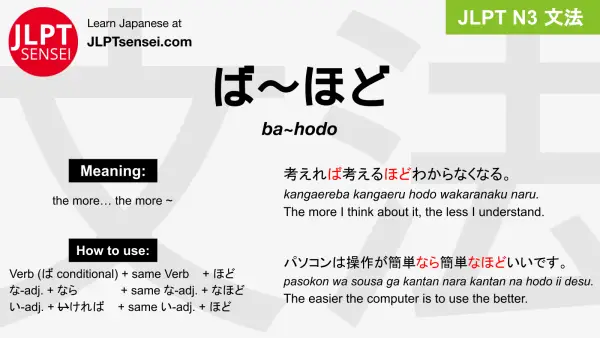
jlptsensei.com
Can be found here.
This website contains grammar points categorized by their JLPT level which makes it easy to go through them from beginner to advanced.
新完全マスター文法
This is the name of a textbook which is used in many language schools in Japan.
It does a good job of systematically introducing pretty much every grammar point that you need to know.
Since it is in Japanese, it is fit for more advanced learners.
When working through the grammar, you should make a flashcard for each grammar point.
Other tips
Don't be stubborn
A mistake that I made was that I would always try to "complete" everything I started.
Be that a book, an app etc.
If you feel that you are getting bored with something or that your retention is bad. Just stop and move on to something else.
Having the motivation to keep studying is the most important thing.
Make "how do I say this" notes
One thing that I have found difficult to progress was my speaking. When talking to people, you can naturally only say things that you already know.
So how do you learn new words to use in conversation?
One thing I like to do is to have a "how do I say this" list.
During the day, I will think about how I would say something in Japanese.
This could be something I actually want to say in Japanese during a conversation, but don't know how to. Or something I say in my native language that I then consider how I would say in Japanese.
Or just thoughts that pop into my head or something I see.
If I don't know how to say it in Japanese, I make a note on my phone.
Then I go through my notes, figure out how to say the thing in Japanese, and make a flashcard for it.
Your Anki "maximum interval" should be infinite.
It might feel a bit scary to press "good" and send a card 4 years into the future.
But that is the point. Cards are meant to be "destroyed" after you have learnt what is written on them.
It is much more powerful to "rediscover" a word in a natural way, say, while reading a book, than it is to review it in Anki.
Flashcards are nothing more than a crutch that can help you remember a word until you see it in the wild again.
Once you reach a high level of language comprehension, you will retain your knowledge of the language just by using it.
Your Anki "daily review limit" should be infinite
If you feel that you are getting too many reviews per day, decrease the amount of new cards that you put in.
The algorithm is fine tuned to show you a card at exactly the right time. So not doing all your reviews every day messes with the system.
The JLPT exam is good motivation
Some people complain that the JLPT does not accurately gauge your Japanese level.
While there is some truth to this, I think that it is pretty accurate, especially for reading.
Anyway, whether the JLPT is a good test or not, or whether you need it for anything, I recommend you take it.
Doing so will give you guidance on what you should be focusing on, and passing the exam is a good goal that can motivate your studies.
Final words
Thank you for reading this post.
As people who know me in real life know, this is a topic that I love to talk about.
This guide is quite opinionated (bordering on a rant?). I don't claim to have any evidence that this is the most efficient way to studying Japanese. But it is what worked for me.